An athlete's image in marketing: the Lewandowski case
Robert Lewandowski is breaking popularity records.
In this post
He is one of the most visible people in Poland, as his frequent presence in ad campaigns for all sorts of brands makes clear. How many of them can you name? The demand from advertisers is tied to the football at Euro 2016, but “Lewy” doesn't represent that one branch of marketing alone.
Which brands has Lewandowski advertised?
Lewandowski has already appeared in ads for brands including:
Huawei:
https://www.youtube.com/embed/c2uw1xvwD-k?feature=oembed
https://www.youtube.com/embed/EAnQKgSohoA?feature=oembed
Lotos:
https://www.youtube.com/embed/zY9N23sbJFk?feature=oembed
Head & Shoulders:
https://www.youtube.com/embed/eTeH22SrJnE?feature=oembed
Nike:
https://www.youtube.com/embed/vUoa0f5i0xo?feature=oembed
He recently showed off his singing as well, in a T-Mobile ad where he takes to a football pitch with Tomasz Kot and a troupe of dancers and sings along to Robin Thicke's “Blurred Lines”:
https://www.youtube.com/embed/oSC_UEnehYQ?feature=oembed
How are audiences reacting?
So how do audiences react to it? Among them you'll find both supporters and opponents of Robert's advertising work.
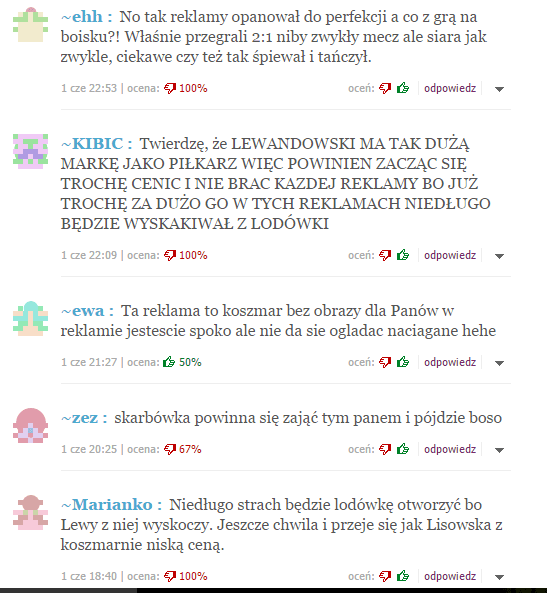

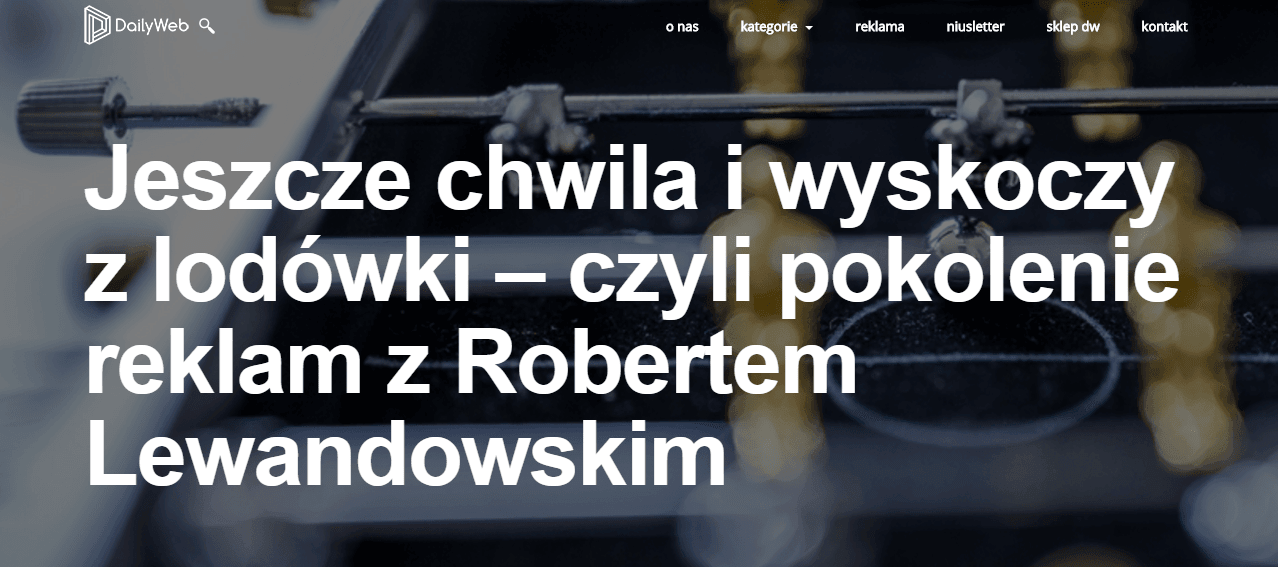
On one point, though, the internet agrees: the running line is that “the only place you won't find Robert Lewandowski is inside your fridge”.
What do the experts say?
In principle, a famous person raises the prestige of the brand they advertise. Not, however, when they are the face of so many brands that in the end they aren't associated with any of them. As Ewa Sieńkowska, a communication strategy specialist, sees it, “a celebrity really only makes sense when their image embodies some strong brand value, when they support the brand's identity naturally rather than by force. Otherwise what we unfortunately have is a lack of any idea for the communication, or a pushy attempt to make use of someone who is on top right now and on the eve of the Euros”. Plenty of marketers think campaigns like that don't deliver what they were meant to. But these are moves that Lewandowski and the specialists who manage his image agreed to.

An image used without consent – the Platforma Obywatelska case
It's a completely different matter when that consent was never given. One example is what Platforma Obywatelska, a Polish political party, put out in October 2015, when a photo of Robert Lewandowski in the Poland national team kit went up on the party's official profile. The party lined up the player's 13 goals with the identical number of days left before the parliamentary election.
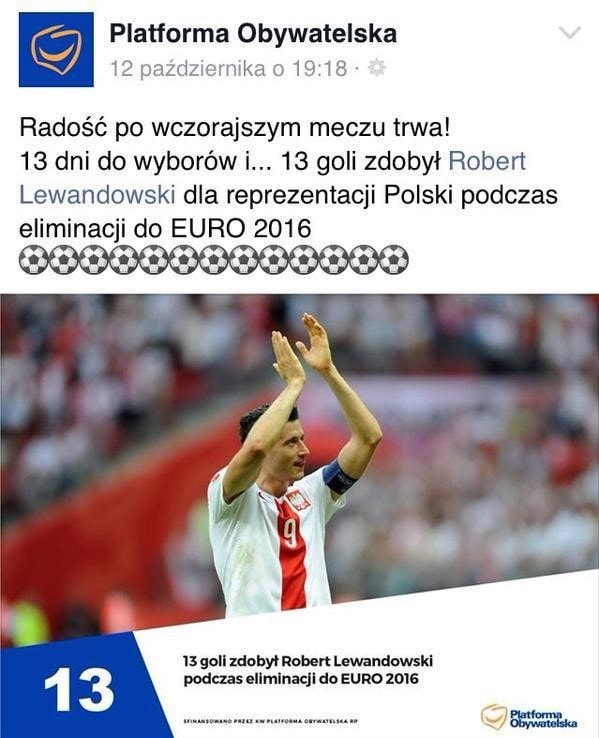
That is obviously promotion for the party, and using “Lewy's” image in the national team kit requires the consent of the Polish Football Association, PZPN. In response, PZPN posted a statement on its official website saying that “using the image of a member of the national squad in the national team kit in this way, without authorization, constitutes a breach of PZPN's exclusive statutory rights”. To stay on the right side of the marketing rules, the party should have asked the association for permission to use the images of national squad players. At PZPN's demand, the photo had to come down.
Lewandowski's presence in so many promotional campaigns doesn't help build a distinctive brand image; it actually weakens it, going along with the general fashion. The same goes for the player himself, who isn't identified with one particular company presenting values associated with what he does. It is worth noting, though, that he picks brands associated with professionalism and a strong market position. We're curious whether “Lewy” will be in the same demand once Euro 2016 is over. Do you think it will have anything to do with the results of the next few matches?
 MarketingSocial LamaInfluencer vs. UGC creator – what's the difference?In online marketing we keep running into the terms “influencer” and “UGC creator” (User-Generated Content). Both roles revolve around making content, but they differ in their goal, their scope, their relationship with brands and the way they reach an audience. Choosing between an influencer and a UGC creator comes down to a company's marketing strategy. What is an influencer? An influencer is someone who builds their own community on social media and, thanks to that recognition, influences what their followers decide to do.READ POST
 Marketing
 Łukasz PłocińskiCan your Instagram posts show up in Google results?Can your Instagram posts show up in Google results? Until recently that was rare, but the breakthrough has arrived. As of July 10, 2025, Instagram officially lets Google index public content from professional accounts (business and creator). That means photos, videos and Reels from those accounts can turn up in Google – alongside websites, blogs and YouTube videos.READ POST
 MarketingSocial LamaThe best Instagram hashtags to grow your reach on social mediaHashtags on Instagram are one of the most effective ways to grow your reach and get in front of new audiences without paying for ads. According to the latest research, posts with well-chosen hashtags can pull up to 70% more reach than posts with no tags at all. In a world where Instagram's algorithm keeps getting stricter, using hashtags well can be the key to a successful social media strategy.READ POST